Biometric authentication has become a core technology in modern security systems, replacing traditional methods such as passwords, ID cards, and PIN codes. Among the most widely used biometric technologies are fingerprint recognition and Reconnaissance de veine palmaire.
While fingerprint systems have been widely adopted for years due to their convenience and low cost, palm vein recognition technology is rapidly emerging as a more secure and contactless alternative, especially in high-security environments such as enterprises, banks, hospitals, and government facilities.
This article provides a detailed comparison between palm vein recognition vs fingerprint recognition, focusing on security, accuracy, usability, and real-world applications.
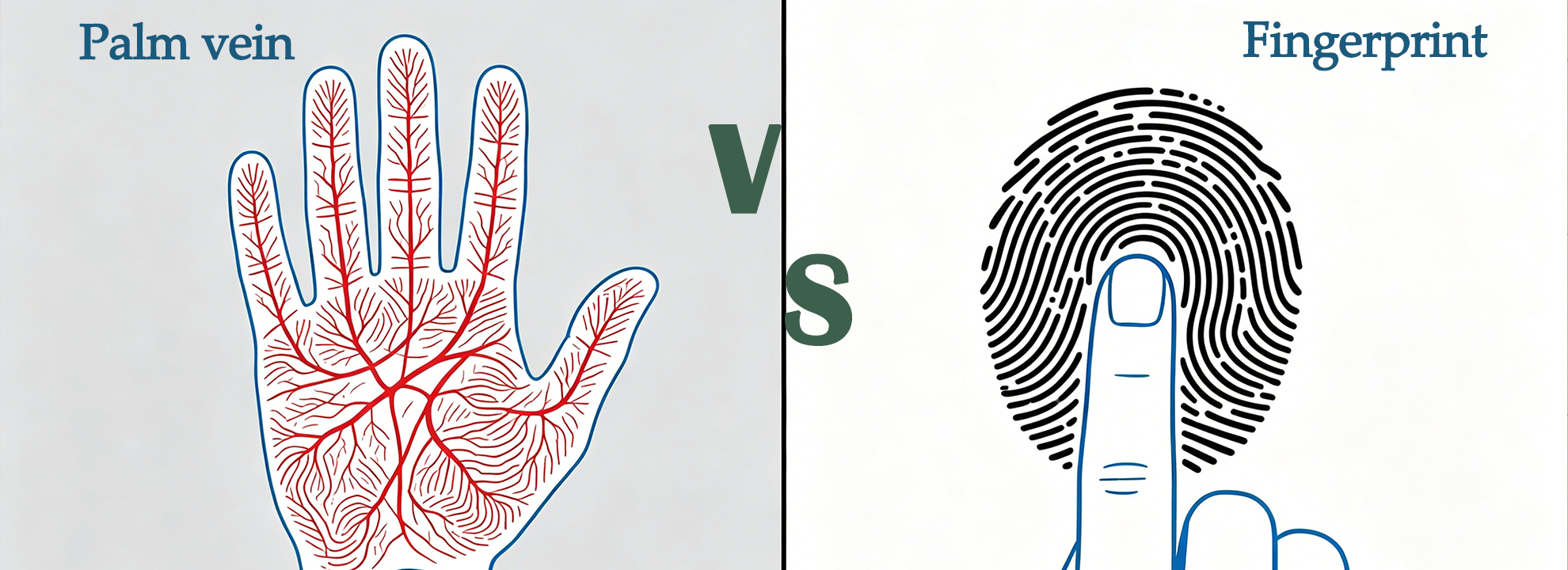
What Is Fingerprint Recognition?
Fingerprint recognition is a biometric method that identifies individuals based on the unique patterns of ridges and valleys on their fingertips.
How it works:
• A fingerprint sensor (optical, capacitive, or ultrasonic) captures the fingerprint image and enhances it to improve clarity and reduce noise.
• The system extracts unique features called minutiae points, such as ridge endings and bifurcations.
• These features are converted into a secure digital template and stored in a database or cloud system instead of the original image.
• During authentication, a new fingerprint is scanned and processed in the same way, then compared with stored templates using a matching algorithm.
• If the match score meets the required threshold, identity is verified and access is granted; otherwise, it is rejected.
Avantages :
• Low deployment cost and mature technology, widely used in attendance systems, mobile devices, and access control applications
• Fast authentication speed with millisecond-level matching, suitable for high-frequency verification scenarios such as office entry and time attendance
• Strong ecosystem compatibility, easy integration with most biometric devices, operating systems, and security platforms
• Compact sensor design, simple hardware structure, and low power consumption, suitable for embedded and large-scale deployment
Limitations
• Sensitive to finger conditions such as dryness, moisture, dirt, or physical damage, which may affect recognition accuracy
• Vulnerable to spoofing attacks using fake fingerprints, silicone molds, or lifted prints if liveness detection is insufficient
• Requires physical contact with sensors, which may raise hygiene concerns in shared or public environments
• Performance can degrade over time in industrial environments where fingerprints may wear out due to manual labor
2. What Is Palm Vein Recognition?
Palm vein recognition is an advanced contactless biometric authentication technology that identifies individuals based on unique vascular patterns inside the human palm. It uses near-infrared (NIR) imaging technology to capture subcutaneous vein structures, which are then converted into a secure biometric template.
How it works:
Near-infrared (NIR) light is emitted onto the palm → hemoglobin in the blood absorbs the infrared light → vein patterns appear as internal vascular structures → the system extracts and maps the palm vein biometric pattern → a digital template is generated → authentication is completed using secure matching algorithms with built-in liveness detection
Unlike fingerprint biometrics, palm vein recognition relies on internal biological features, making it extremely difficult to replicate, forge, or steal.
Avantages
• Extremely high security based on internal biometric patterns (palm vein recognition uses subcutaneous vascular structures, making spoofing nearly impossible compared to external biometrics)
• Strong built-in liveness detection using near-infrared (NIR) technology, ensuring authentication only works with live blood flow signals
• Fully contactless biometric authentication, improving hygiene and making it ideal for hospitals, cleanrooms, and high-traffic environments
• Stable biometric characteristics that remain unchanged over time and are not affected by aging, dirt, or surface damage
• High recognition accurac
Limitations
• Higher hardware cost due to the use of near-infrared imaging sensors and specialized biometric components
• More complex device structure compared to fingerprint systems, requiring more advanced integration and calibration
• Lower adoption rate in consumer electronics, mainly used in enterprise, government, and high-security access control systems
• Slightly stricter hand positioning requirement during scanning, which may affect user familiarity at first use
Security Comparison: Palm Vein vs Fingerprint
1. Spoof Resistance
Reconnaissance des empreintes digitales :
Can be spoofed using artificial replicas such as silicone fingerprints, lifted prints, or high-resolution images.
Palm Vein Recognition:
Highly secure because vein patterns exist inside the body and require live blood flow detection using near-infrared technology.
2. Data Protection
Fingerprint data is based on external surface patterns that can be captured visually or physically.
Palm vein data is based on internal physiological structures that cannot be exposed externally.
Palm vein systems also rely on liveness detection, significantly reducing the risk of unauthorized replication.
3. Stability Over Time
Fingerprints may be affected by aging, manual labor, or physical damage over time.
Palm vein patterns remain stable throughout a person’s lifetime and are not affected by surface conditions.

Précision et fiabilité
Reconnaissance des empreintes digitales :
Accuracy can be affected by wet, dry, dirty, or damaged fingers, as well as sensor quality and environmental conditions.
Palm Vein Recognition:
Less affected by external conditions and remains stable even with dirty hands, skin damage, or environmental changes due to internal biometric imaging.
In high-security environments, palm vein recognition provides more stable and consistent authentication performance.
Hygiene and Contactless Authentication
Post-pandemic demand has significantly increased the need for contactless biometric authentication technologies.
Fingerprint systems require physical contact with sensors, which may increase contamination risks in shared environments.
Palm vein recognition is fully contactless, reducing hygiene risks and making it ideal for sensitive environments such as healthcare, cleanrooms, and food processing industries.
Cost and Deployment Considerations
Fingerprint Systems:
Lower initial cost, easy deployment, and suitable for mass-market applications.
Palm Vein Systems:
Higher hardware cost due to near-infrared imaging technology, but better suited for enterprise-grade security environments requiring high accuracy and anti-spoofing capabilities.
Fingerprint is more cost-effective, palm vein offers higher security.
Scénarios d'application
Fingerprint Recognition Applications
• Smartphones and tablets for device unlocking and user authentication
• Employee time attendance systems in offices and small businesses
• Residential access control and smart door locks
• Educational institutions for student attendance management
• Retail stores and commercial buildings requiring cost-effective biometric access
Palm Vein Recognition Applications
• Enterprise access control systems requiring high-security authentication
• Banking and financial institutions for secure identity verification
• Hospitals and healthcare facilities where contactless authentication is preferred
• Government agencies and critical infrastructure with strict security requirements
• Advanced attendance management systems for factories, laboratories, and large organizations
• Integrated turnstile gates and smart building access solutions for secure, touch-free entry


Integration in Modern Access Control Systems
Modern biometric security systems often combine multiple authentication methods to enhance security and flexibility, such as fingerprint, face recognition, RFID/NFC cards, and palm vein recognition.
In enterprise environments, palm vein recognition is frequently integrated into:
Access control terminals, time attendance systems, turnstile gate systems, and cloud-based biometric management platforms.
This multi-modal approach improves both security performance and operational efficiency in modern smart buildings and enterprise security infrastructures.
Which Is More Secure?
| Feature | Empreinte digitale | Veine de la paume |
|---|---|---|
| Spoof resistance | Moyen | Very High |
| Sans contact | Non | Oui |
| Stabilité | Moyen | Haut |
| Hygiène | Faible | Haut |
| Coût | Faible | Medium–High |
| Sécurité d'entreprise | Moyen | Very High |
Palm vein recognition provides a higher level of security than fingerprint recognition, especially in enterprise, government, and high-risk authentication environments.
Conclusion
While fingerprint recognition remains a practical, widely used, and cost-effective biometric authentication method, it has limitations in spoof resistance, environmental sensitivity, and hygiene concerns.
Palm vein recognition technology offers a more advanced and secure alternative by leveraging internal vascular patterns that are extremely difficult to replicate or forge. As organizations move toward contactless, high-accuracy, and enterprise-grade biometric authentication systems, palm vein recognition is expected to play an increasingly important role in the future of security and identity verification.
