
As biometric security rapidly evolves, two technologies dominate the global market: iris recognition and face recognition. Organizations upgrading access control, attendance management, or smart gate systems often ask:
“Is iris recognition more accurate than face recognition?”
The short answer:
👉 Yes — iris recognition is significantly more accurate and secure, especially in high-security environments.
This article compares both technologies in terms of accuracy, security, performance,
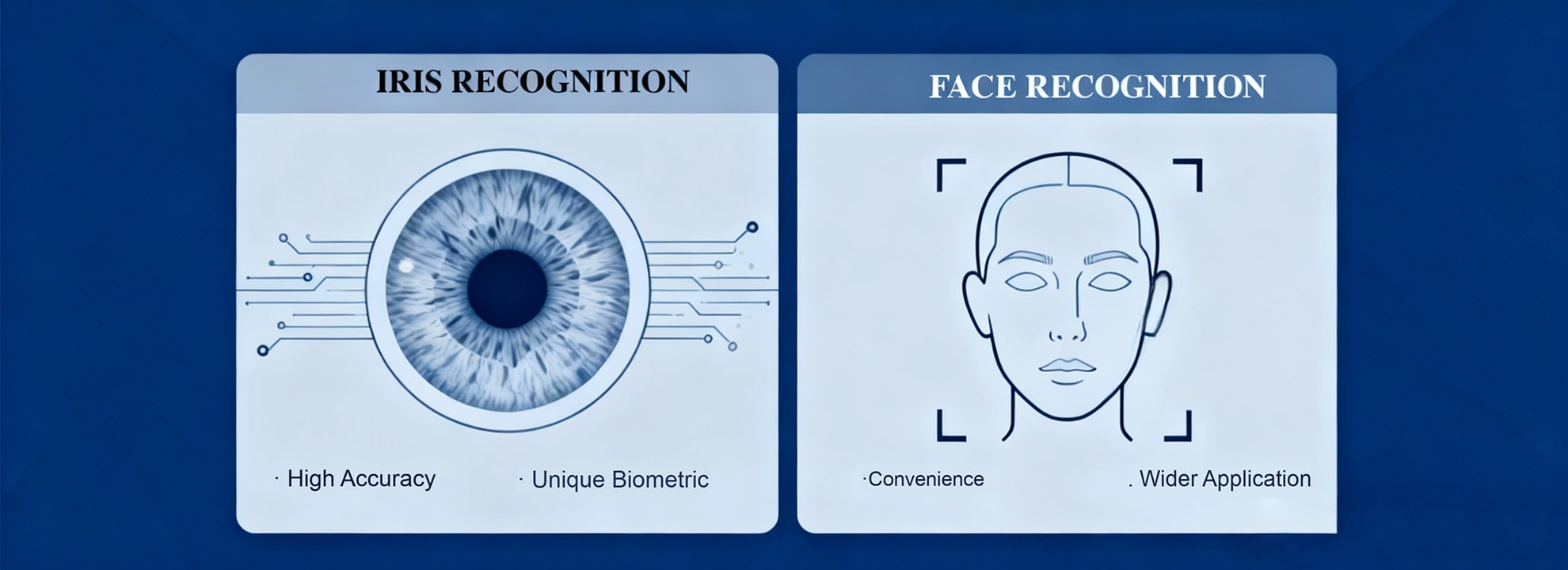
What Is Iris Recognition?
Iris recognition uses a high-resolution camera to capture the unique patterns of the human iris. These patterns remain stable from childhood through adulthood, making iris recognition one of the most consistent biometric identifiers.
Key characteristics of iris recognition:
Extremely high matching accuracy
Works even with face masks, glasses, beards
Lower false acceptance rate (FAR)
Strong protection against spoofing attempts
Ideal for secure access control, government identity verification, and border control
What Is Face Recognition?
Face recognition analyzes the geometry of a person’s facial features to identify or verify identity. It is fast, convenient, and widely used across consumer devices and enterprise attendance systems.
Characteristics of face recognition:
Fast and highly user-friendly
Works at longer distances
More affected by lighting, pose, masks, and aging
Higher false acceptance rate than iris recognition
Accuracy Comparison: Iris vs Face Recognition
| Metric | Nhận dạng mống mắt | Nhận dạng khuôn mặt |
|---|---|---|
| Accuracy Rate | 99.7% – 99.9% | 95% – 98% |
| False Acceptance Rate (FAR) | 1 in 1,000,000 | 1 in 1,1,000 – 1 in 10,000 |
| False Rejection Rate (FRR) | Extremely low | Moderate, varies with lighting |
| Liveness Detection Strength | Very strong | Medium to strong |
| Resistance to Spoofing | Cao | Trung bình |
Iris recognition delivers higher accuracy and lower error rates than face recognition.
Why Is Iris Recognition More Accurate?
1. The Iris Has More Unique Data Points
An iris contains over 240 unique features, while a face has far fewer stable markers.
2. Less Interference From Environment
Iris recognition is unaffected by:
lighting variation
masks
face angles
facial hair
aging
3. More Robust Anti-Spoofing
Iris biometrics resist attacks involving:
printed photos
3D masks
deepfake face videos
Performance Comparison in Real Scenarios
| Scenario | Iris Recognition Performance | Face Recognition Performance |
|---|---|---|
| Mask Wearing | No impact | Strongly affected |
| Outdoor Sunlight | High accuracy | Accuracy decreases |
| Night / Low Light | Excellent | Moderate |
| User Distance | 20–50 cm | 0.5–3 meters |
| High-Security Areas | Best choice | Acceptable |
| High Traffic / Fast Passage | Good | Excellent |
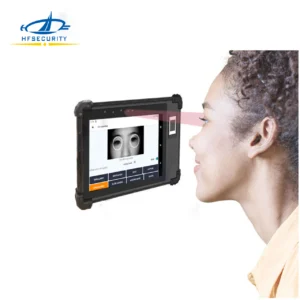

Security Comparison: Which Is Safer?
Iris Recognition Advantages
Almost impossible to duplicate
Stable throughout life
Excellent liveness detection
Suitable for banks, airports, government, defense, hospitals
Face Recognition Advantages
Fast enrollment
Highly convenient
Suitable for office attendance, turnstile systems, smartphones, retail
Environmental Adaptability
Nhận dạng mống mắt
Works in bright or dim light
Works through most glasses and face masks
Works even with small changes in pupil dilation
Nhận dạng khuôn mặt
Can struggle with:
backlighting
side lighting
sunglasses
face masks
drastic facial expression changes
Which Biometric Technology Should You Choose?
Choose Iris Recognition if you need:
Maximum security
Near-perfect accuracy
Protection against spoofing
Consistent results in all environments
Sensitive access control applications
Choose Face Recognition if you need:
High-speed identification
Touch-free convenience
Low hardware cost
Attendance and visitor management
Integration with turnstiles and mobile devices
Phần kết luận
iris recognition is significantly more accurate than face recognition, especially in environments requiring strict security, consistent performance, and maximum reliability.
However, both technologies offer unique strengths, and many modern systems combine face + iris recognition for multi-factor biometric authentication.
Câu hỏi thường gặp
Yes. Iris recognition offers 99.7%–99.9% accuracy, far higher than most face recognition systems. The iris has more unique patterns, is less affected by lighting, and remains stable for life, resulting in lower false acceptance and false rejection rates.
Iris patterns cannot be duplicated or forged easily. High-quality systems use advanced liveness detection, infrared imaging, and anti-spoofing algorithms to prevent attacks using photos, videos, or masks—making iris biometrics ideal for high-security access control.
Face recognition accuracy decreases significantly when the face is partially covered. Masks and sunglasses hide important facial features, reducing detection reliability. Iris recognition, however, performs accurately even when the user is wearing a mask.
Face recognition is generally faster and can scan users from greater distances (0.5–3m). Iris recognition requires users to be closer (20–50 cm) but delivers higher accuracy and stronger security.
Yes. Iris recognition uses infrared imaging, allowing it to work in complete darkness or very low light. This makes it more reliable than many face recognition systems that depend on ambient lighting.
Yes. Many advanced access control devices combine face + iris + palm vein + NFC for enhanced accuracy and multi-layered security. Using multiple biometrics reduces the chance of false matches and improves system robustness.
