
In today’s security-driven environment, organizations are rapidly shifting from traditional key-based or card-based entry systems to more advanced and reliable solutions. Among these innovations, the Biometric Access Control System with Face Recognition and Fingerprint Scanner has become one of the most widely adopted technologies for modern identity verification and secure access management.
This system combines multiple biometric authentication methods to ensure higher accuracy, stronger security, and faster user identification. As a result, it is widely used in offices, factories, gyms, schools, hospitals, and high-security facilities.

What Is a Biometric Access Control System?
A biometric access control system is a security solution that verifies a person’s identity using unique biological characteristics. Unlike traditional access methods such as passwords, PIN codes, or RFID cards, biometric systems rely on physical traits that are difficult to duplicate.
In particular, face recognition and fingerprint scanning are two of the most commonly used biometric technologies due to their high accuracy and convenience.
Moreover, when these technologies are combined into one system, they create a multi-layer security solution that significantly reduces unauthorized access risks.
How Face Recognition and Fingerprint Scanner Work Together
The integration of face recognition and fingerprint scanning provides a dual authentication system that enhances both security and efficiency.
1. Face Recognition Technology
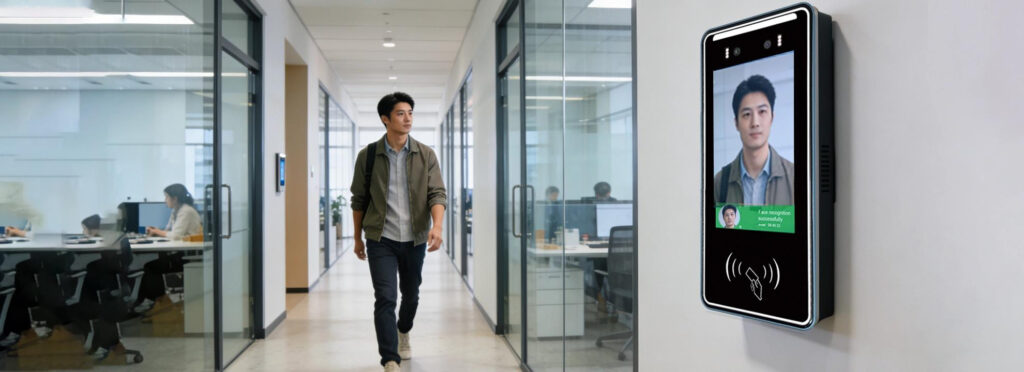
Face recognition uses AI-based algorithms to analyze facial features such as the distance between eyes, nose shape, and jaw structure. When a user approaches the system, the camera captures the face and compares it with the stored database.
Consequently, this allows for fast, contactless identification, making it ideal for high-traffic areas.
2. Fingerprint Scanner Technology
Fingerprint scanning works by capturing and analyzing unique fingerprint patterns. Since no two fingerprints are identical, this method provides highly accurate identity verification.
In addition, fingerprint authentication is widely used in environments where stronger physical security is required.
3. Combined Operation
When both technologies are integrated into a single access control system, users can be verified through either method or a multi-factor authentication mode.
As a result, organizations can balance convenience and security depending on their operational needs.
Key Features of Biometric Access Control Systems
A modern biometric access control system typically includes several advanced features designed to improve security and usability.
1. High-Accuracy Identity Verification
Because biometric identifiers are unique to each individual, the system significantly reduces identity fraud and unauthorized entry. It uses advanced algorithms to ensure fast matching speed and high recognition accuracy even in complex lighting or crowded environments.
2. Fast and Contactless Access
Face recognition enables touch-free entry, which is especially important in environments requiring hygiene and speed, such as hospitals and gyms. Users can be identified within seconds without physical interaction, improving overall entry efficiency during peak hours.
3. Multi-Authentication Options
In addition to face and fingerprint recognition, many systems can integrate RFID cards, QR codes, or PIN codes for flexible access control. This allows organizations to customize security levels based on different user roles and access zones.
4. Real-Time Monitoring
Access events are recorded in real time, allowing administrators to monitor entry logs, attendance data, and security alerts instantly. This helps improve operational transparency and enables quick response to any unauthorized access attempts.
5. System Integration Support
Most biometric systems support SDK and API integration, making it easy to connect with existing attendance management or security platforms. This ensures seamless data synchronization and allows businesses to build a centralized management system.
Advantages of Using Biometric Access Control Systems
The adoption of biometric access control systems brings several important benefits to organizations, especially in terms of security, efficiency, and long-term cost control.
Enhanced Security
Firstly, biometric identifiers are extremely difficult to replicate, which greatly reduces the risk of identity theft or unauthorized entry. Compared to traditional cards or passwords, biometric authentication provides a much higher level of protection for restricted areas.
Improved Efficiency
Secondly, authentication is fast and automated, reducing waiting time at entry points and improving overall traffic flow. This is particularly beneficial in high-traffic environments such as offices, gyms, and factories where quick access is essential.
Reduced Operational Costs
In addition, businesses can reduce dependency on manual security checks and physical key management, lowering long-term operational costs. Fewer security staff are required at entry points, while system automation handles most access verification tasks.
Better User Experience
Furthermore, employees or members can enjoy seamless access without needing to carry cards or remember passwords. This creates a smoother and more convenient entry experience, improving overall satisfaction and engagement with the facility.
Applications Across Industries
Biometric access control systems are widely used across different industries due to their flexibility and reliability.
Office Buildings
They help manage employee attendance and secure restricted areas.
Gyms and Fitness Centers
They ensure only registered members can access facilities, improving membership control.
Factories and Industrial Sites
They provide secure entry for workers and track shift attendance efficiently.
Educational Institutions
They help control campus access and monitor student attendance.
Healthcare Facilities
They ensure only authorized staff can access sensitive medical areas.
Why Businesses Are Choosing Biometric Systems
As security threats continue to evolve, businesses are looking for more reliable access control solutions. Therefore, biometric systems are becoming the preferred choice due to their accuracy and automation capabilities.
In addition, the combination of face recognition and fingerprint scanning provides a balance between convenience and high-level security.
Moreover, with the advancement of AI and cloud-based management systems, biometric access control is becoming more intelligent and scalable than ever before.
Future Trends in Biometric Access Control
Looking ahead, biometric access control systems will continue to evolve with emerging technologies such as:
- AI-powered identity recognition
- Cloud-based access management
- Mobile biometric authentication
- Multi-modal biometric fusion systems
As a result, access control systems will become more intelligent, adaptive, and secure.
Conclusion
The Biometric Access Control System with Face Recognition and Fingerprint Scanner represents a modern, efficient, and highly secure solution for identity verification and access management.
By combining multiple biometric technologies, it offers improved security, faster access, and better operational efficiency for organizations across various industries.
As businesses continue to upgrade their security infrastructure, biometric access control systems will remain a key technology in shaping the future of smart access management.
