As manufacturing continues to embrace digital transformation, businesses are looking for more efficient ways to manage employees, monitor attendance, and improve security. A smart factory attendance system is no longer just a tool for recording clock-in and clock-out times—it has become an essential part of workforce management and operational optimization.
With technologies such as Nhận diện khuôn mặt, fingerprint authentication, Nhận diện tĩnh mạch lòng bàn tay, and cloud-based attendance management, factories can automate processes, reduce manual errors, and gain real-time insights into employee activity. However, selecting the right solution requires careful evaluation of your business needs and long-term goals.
This guide explains the most important factors to consider when choosing a smart factory attendance system.
Why Factories Need a Smart Attendance System
Attendance management today is directly linked to payroll accuracy, workforce planning, and production efficiency. Manual methods are no longer sufficient for modern industrial environments.
A smart factory attendance system helps companies automate employee tracking, reduce human error, and provide real-time visibility into workforce operations.
Limitations of traditional attendance methods
- Paper-based systems and punch cards often lead to missing records, buddy punching, and manual correction issues. These problems increase as workforce size grows, especially in multi-shift factories.
Shift toward digital workforce management
Digital systems automatically record attendance data and synchronize it across platforms. Managers can instantly access reports and monitor workforce performance without manual calculations.
Key features to look for in a smart factory attendance system
A high-quality system should not only record attendance but also support operational efficiency, security, and future scalability.
1. Biometric authentication technology
Biometric identification ensures that each employee is accurately verified using unique physical characteristics.
Face recognition offers fast, contactless verification and is ideal for high-traffic factory entrances. Fingerprint recognition is widely used due to its stability and cost efficiency. Palm vein recognition provides a higher level of security by scanning internal vein patterns that are extremely difficult to replicate.
2. Cloud-based attendance management
Cloud platforms allow attendance data to be stored and managed centrally. This enables real-time access from different locations and simplifies system maintenance.
For factories with multiple sites, cloud deployment significantly improves management efficiency.
3. Real-time reporting and analytics
Modern systems provide dashboards that display attendance status, overtime records, absenteeism trends, and workforce statistics. This allows managers to make faster and more accurate decisions.
4. Flexible shift scheduling
Factories often operate with complex shift structures. A smart attendance system should support rotating shifts, overtime rules, holidays, and customized attendance policies without manual intervention.

System compatibility and integration with enterprise operations
A smart factory attendance system must integrate with existing business systems to maximize efficiency.
Integration with HR and payroll systems ensures that attendance data is automatically synchronized, reducing manual work and preventing salary calculation errors.
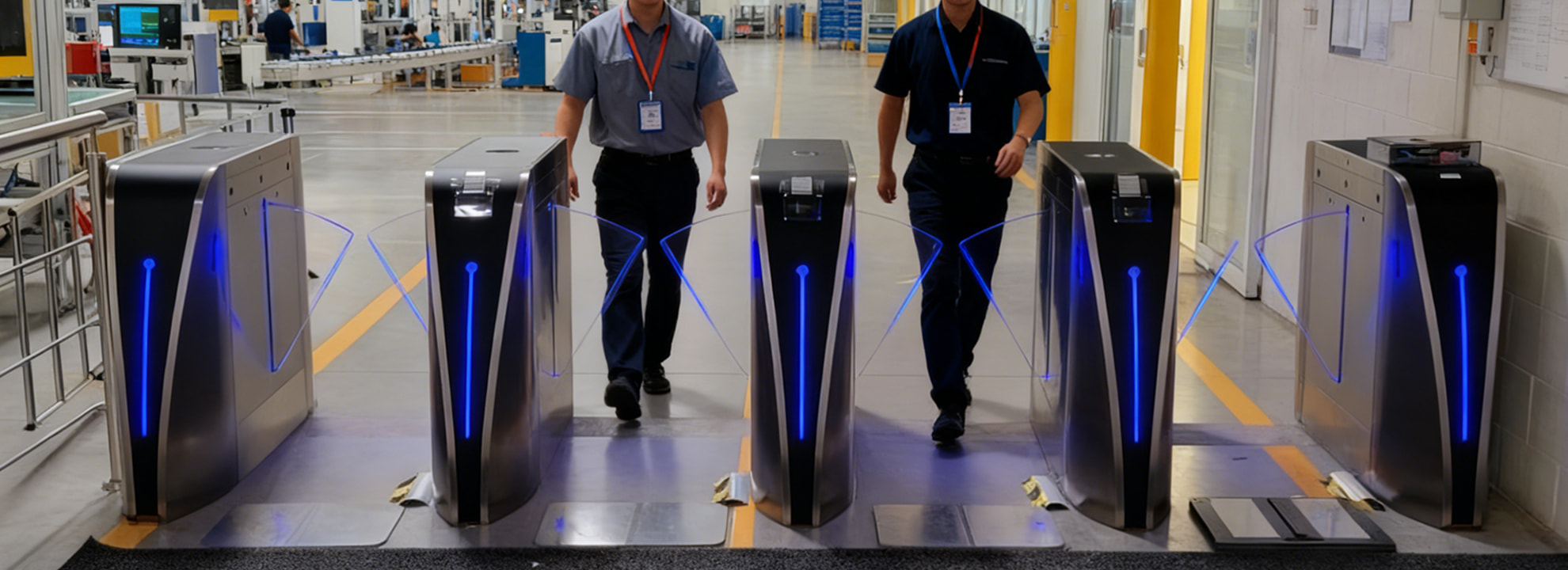
Many factories also integrate attendance systems with access control devices such as doors or turnstiles. This allows employee verification and entry control to happen simultaneously.
For long-term scalability, API or SDK support is important because it allows the system to connect with ERP platforms or customized enterprise software.
Scalability and long-term system value
A factory attendance system should not only meet current needs but also support future expansion.
As factories grow, the system must handle more employees, more devices, and more locations without performance issues.
Centralized multi-site management allows headquarters to monitor all factories in one system while still maintaining local control.
A scalable architecture also ensures that new features and modules can be added without replacing the entire system.
Common mistakes when selecting a system
One of the most common mistakes is choosing a system based only on price. Low-cost systems often lack advanced software functions such as analytics and cloud support.
Another mistake is focusing only on hardware while ignoring software capability. In reality, software determines how useful the system is in daily operations.
Finally, many companies underestimate the importance of vendor support. Without proper technical support and updates, system performance can degrade over time.
Best practices for implementation
Before deployment, factories should analyze employee flow, shift schedules, and entry points to ensure proper system layout.
Employee training is also important to ensure smooth adoption and reduce operational errors during early stages.
After implementation, continuous monitoring of attendance data helps improve workforce planning and optimize factory efficiency.

Phần kết luận
A smart factory attendance system is a critical part of modern manufacturing digital transformation. It combines biometric technology, cloud computing, and enterprise integration to improve workforce efficiency and operational accuracy.
The best system is not the one with the most features, but the one that fits real factory workflows, supports long-term scalability, and integrates seamlessly with existing systems.
By evaluating biometric performance, software intelligence, integration capability, and scalability, manufacturers can build a more efficient and data-driven workforce management system.
